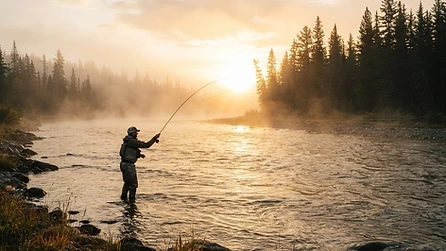
Finding and reading water is the skill that separates anglers who catch trout from anglers who cast at water. It's two skills in one: first, finding water that holds trout — knowing which rivers, streams, and lakes to go to — and second, reading that water once you're there, knowing exactly where to cast. Trout are not random. They hold in predictable places, and those places are defined by three things: current, structure, and depth. Learn to find water and read it, and you'll spend less time casting at empty water and more time catching fish.
Finding water starts with knowing what trout need. Trout need cold, clean, oxygenated water. That means rivers and streams with good flow, lakes and reservoirs with cold-water inlets or sufficient depth to stay cold, and water that's clean enough to support insects and baitfish. Look for rivers with a gradient — water that drops and flows, not flat, slow water. Look for lakes with depth — shallow lakes warm up too much in summer and don't hold trout year-round. Look for water with structure — rocks, logs, undercut banks, and weed beds that provide cover and feeding lanes. Water that has all three — cold, clean, and structured — holds trout.
Maps and research are the first step in finding water. Topographic maps show river gradient and lake depth. State fisheries websites and fishing reports tell you which waters are stocked and which hold wild fish. Local tackle shops know what's fishing well. Satellite imagery on your phone can show you access points, river structure, and water clarity before you even leave home. Do your homework before you go — an hour of research saves a day of fishing empty water. The best water is often not the most famous water; it's the water that has the right conditions and the least pressure.
Once you're on the water, reading it is the next skill. Current is the first thing to read. In rivers, current is everything — it delivers food, oxygenates the water, and defines where trout can hold without exhausting themselves. The key feature in any current is the seam — the line where fast water meets slow water. Trout hold on the slow side of the seam, facing upstream, waiting for food to drift past. Find the seam and you find the fish. Look for seams below riffles, at the inside of bends, at the edges of current breaks like boulders and points, and where a side channel meets the main flow.
Structure is the physical feature of the bottom — pools, riffles, runs, drop-offs, and undercut banks. Trout relate to structure because it provides cover and a feeding lane. A pool below a riffle is a classic structure feature — the riffle provides food and oxygen, and the pool provides depth and safety. When you're reading water, identify the structure first. Pools, runs, riffles, and undercut banks are the places trout want to be. The transition between structures — where a riffle drops into a pool, where a run shallows into a riffle — is where the biggest fish often hold.
Cover is different from structure. Structure is the bottom contour; cover is the object on or above the bottom — a boulder, a log, an undercut bank, a weed bed. Trout use cover as protection from predators and as an ambush point. A pool (structure) with a boulder (cover) in it is better than a pool with nothing in it. When you're reading water, look for cover on structure. A log in a pool, a boulder in a run, an undercut on a bend — these are the spots that hold the biggest fish. The combination of structure and cover is where trophy trout live.
Depth changes with the seasons and the species. In winter, trout are deep — they hold in the deepest pools and runs, where the water is warmest and most stable. In spring, they spread out as the water warms — they move into riffles and shallower runs to feed and, eventually, to spawn. In summer, they go deep again to find cold water, or they hold in fast, oxygenated water at the heads of riffles. In fall, they're moving and feeding aggressively, and they can be anywhere from deep pools to shallow riffles. Brown trout prefer deeper, slower water. Rainbows prefer faster, shallower water. Brookies and cutthroats prefer small, cold water. Match the depth to the season and the species, and you'll find the fish.
Knowing where to cast is the final step. Once you've found the water, read the current, identified the structure, and spotted the cover, pick the one spot that combines all three — a pool with cover in it, at the right depth, on the seam between fast and slow water. That's where the fish is. Cast above the spot, let the bait drift or swim through it, and pause in the strike zone. Don't cast at the whole river — cast at the one spot that has everything a trout wants. The fish are almost always in the first spot you should have fished. Ten minutes of looking saves two hours of casting at empty water.
Reading water is a skill that compounds. Every hour you spend looking at water and thinking about what the fish are doing makes you better at it. The anglers who consistently catch trout aren't the ones with the most expensive gear or the biggest tackle boxes. They're the ones who can find water and read it — who can look at a river and know where the fish are. Learn to find cold, clean, structured water. Learn to read current, structure, and depth. Learn to pick the one spot that has everything. That's the difference between a good day and a great day on the water.