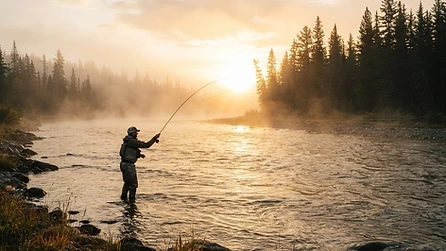
Most anglers waste half their day casting into dead water where a trout would never consider holding. If you want to put more fish in the net, you need to stop looking at the scenery and start reading the river as a series of energy-saving zones. Trout are lazy by design; they gravitate toward spots where they can feed without burning calories fighting the main flow.
The most obvious structure to hunt is the current seam. This is where the fast water meets the slow water, creating a buffer zone that acts as a conveyor belt for food. When you present a suspending crankbait along this edge, you are putting your lure directly in front of a predator waiting for an easy meal to drift by.
Do not ignore the rocks and boulders scattered throughout the middle of the river. A large boulder creates a cushion of slack water on its downstream side, which serves as a prime ambush point for trophy-sized trout. A well-placed cast with a realistic swimbait right behind the rock will often trigger a violent reaction strike from a fish holding in that pocket.
Depths are just as critical as surface turbulence, especially during the heat of the day. As water temperatures rise, trout move toward the bottom of deeper holes and runs where the oxygen levels remain higher. You need to pull out your heavier tackle and get your swimbaits down to the strike zone instead of skimming the surface.
Always look for the transition zones where the river bottom changes from sand to gravel or stone. These areas attract baitfish, which means they are guaranteed to attract trout hunting for a high-calorie snack. If you see signs of bait activity, swap to a pattern that mimics local shiners or chubs to match the hatch effectively.
Finally, pay attention to the shadows cast by overhanging banks or dense vegetation. These shaded areas offer security from predators and protection from the sun, making them consistent hotspots throughout the season. Approach these banks stealthily with long, accurate casts to avoid spooking the fish holding tight to the edge.